Table of Contents
Introduction
Can a spreadsheet be completely accurate and still be wrong about what's actually happening on your floor?
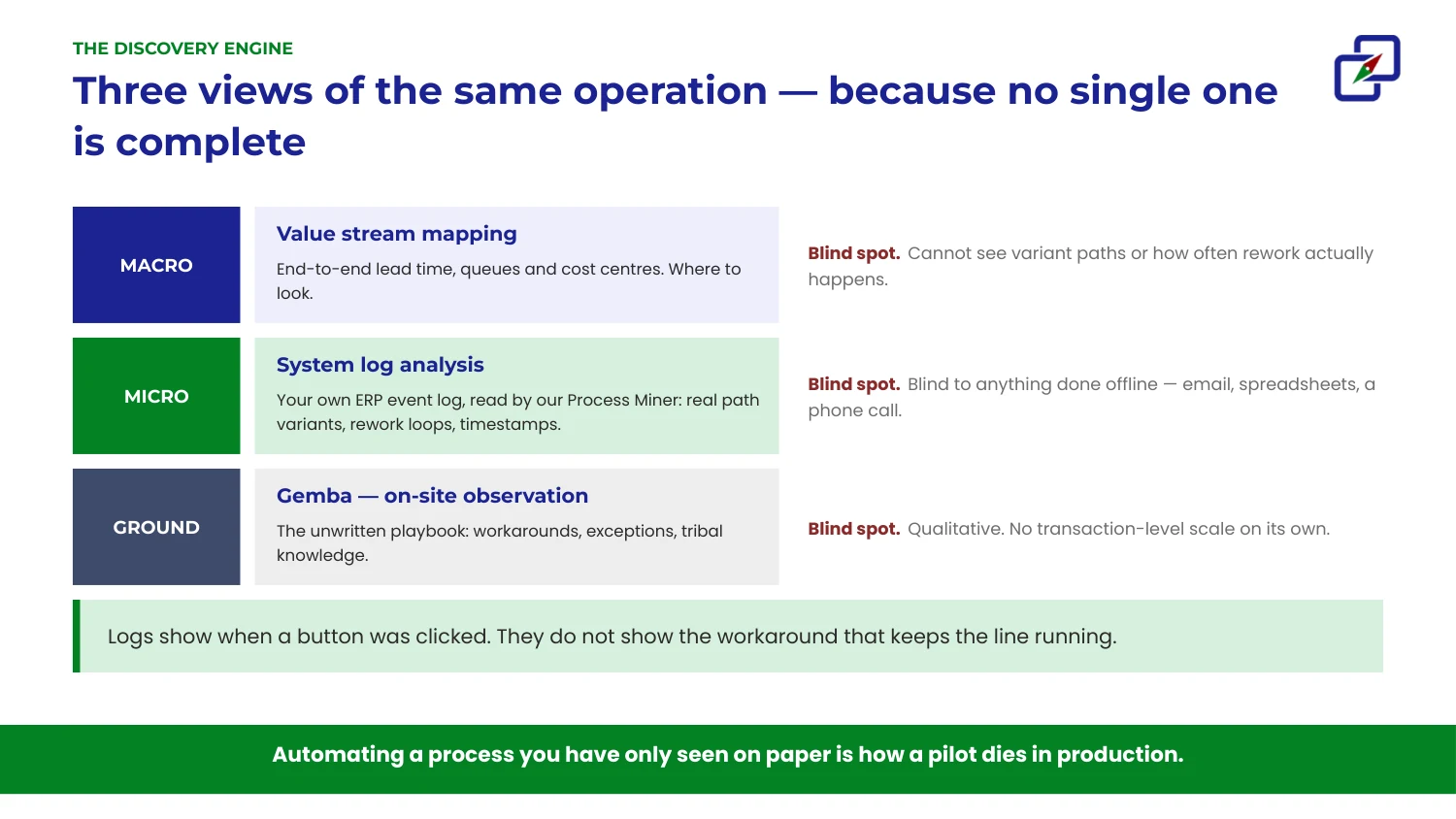
It happens more often than most leadership teams realize. A dashboard reports exactly what someone thought to measure — nothing more — which means it stays silent about any failure mode nobody anticipated when the metrics were designed. This raises an uncomfortable question: how much of what you believe about your own operation is something you've actually seen, versus something you've only read?
In this article, we'll explore Genchi Genbutsu — "go and see for yourself" — Toyota's oldest and least fashionable principle, why it still matters in an age of real-time dashboards, and how to build it into a real habit rather than an occasional gesture.
What Is Genchi Genbutsu?
Genchi Genbutsu translates roughly to "actual place, actual thing." It's one of the oldest principles inside the Toyota Production System, and it simply means that the way to truly understand a problem is to go to where it's happening and observe it directly, rather than relying on a report about it.
"Go to the source to find the facts to make correct decisions."
The Gap Between Accurate and Complete
Dashboards report what someone thought to measure. That's the quiet limitation baked into every reporting system, no matter how sophisticated: the metrics reflect an earlier decision about what was worth tracking, made by someone who couldn't have anticipated every failure mode that would eventually show up on the floor. A cycle-time average can be perfectly correct and still hide the fact that a third of the variance comes from an undocumented workaround an operator built months ago because the "official" step didn't actually work.
Nobody put "hidden workaround" on the dashboard because nobody knew to ask about it. That's not a data quality failure — it's a category of question a spreadsheet, by design, doesn't know to raise.
Factors That Make Go-See Easy to Skip
- Reports Feel Sufficient: A well-built dashboard creates a false sense of complete visibility.
- Time Pressure: Walking the floor takes longer than glancing at a screen.
- Infrequent Visits Feel Like an Event: When leadership rarely appears, the floor performs for the visit instead of behaving normally.
- No Structured Habit: Without a fixed cadence, "go see" quietly becomes "go see when there's time," which is rarely.
Strategies for Building Go-See as a Discipline
1. Make It Frequent, Not Rare
The value comes from ordinariness. Showing up often enough, and quietly enough, that what you're looking at is the real process rather than the process dressed up for an audience.
Practical Ways to Build Frequency
- Route It Through Existing Trips: A short detour past a workstation on the way to another meeting.
- Keep Visits Short: Five to ten minutes, observing rather than interrogating.
- Ask Questions, Don't Assign Blame: The goal is understanding, not an audit.
2. Pair It With a Specific Question
A go-see visit with no purpose tends to become a walkthrough. Go with one specific thing you want to actually observe.
3. Write Down What You Saw, Not What You Were Told
The distinction matters — go-see is about direct observation, and the habit erodes quickly if notes start reflecting secondhand summaries instead of what was actually witnessed.
How This Differs From a Formal Gemba Walk
We've written separately about what a Gemba walk actually is and about what an end-to-end version of the same walk once found — the structured version of this principle, with a defined route and a habit of asking questions rather than assigning blame. Genchi Genbutsu is the broader idea underneath it: the walk is one way to practice go-see, but the principle applies just as well to an unplanned five-minute stop. The format can be informal. The discipline of actually looking, instead of trusting a report about looking, can't be.
Real-Life Case Studies
Case Study 1: Toyota's Founding Principle
Genchi Genbutsu is frequently cited in Toyota's own published management principles as one of the two pillars of its production philosophy, alongside continuous improvement — leadership at every level, including senior executives, is expected to personally verify facts at the source rather than rely exclusively on reports.
Case Study 2: Sam Walton's Store Visits
Walmart founder Sam Walton was widely known for personally visiting stores and distribution centers, often unannounced, well into his tenure as one of the largest retailers in the world — a habit repeatedly cited in business retrospectives as central to keeping leadership decisions grounded in what was actually happening at the register, rather than in headquarters reporting.
Key Takeaways
- A completely accurate report can still miss what actually matters, because it only answers questions someone thought to ask.
- Genchi Genbutsu means going to the source to observe directly, rather than relying on a report about it.
- Infrequent visits perform poorly, because the floor adapts to being watched.
- Frequency and ordinariness are what make go-see effective, not the formality of the visit.
- A formal Gemba walk is one structured way to practice go-see, not the only way.
Related reading: once you are on the floor, the harder skill is seeing what has become familiar. Go and Look covers why nobody sees the waste they walk past every day.
FAQ Section
Q: Isn't this the same thing as a Gemba walk?
A: They're related but not identical. Genchi Genbutsu is the underlying principle; the Gemba
walk is one structured practice for applying it.
Q: What if the data really is accurate — do we still need to go look?
A: Accurate isn't the same as complete. A spreadsheet can correctly report an average while
hiding the fact that half the variance comes from a workaround nobody wrote down.
Q: How often should leadership actually be on the floor?
A: Often enough that showing up isn't an event. If a leader's presence is rare enough to make
people nervous or performative, they're not close enough to what they're supposed to be
understanding.
Q: What's the risk of going too often?
A: In practice this is rarely the failure mode teams run into — the far more common problem is
visits that are too rare, too long, or too focused on assigning blame rather than observing.
Conclusion
In conclusion, no dashboard, however sophisticated, replaces the discipline of going to see for yourself. Genchi Genbutsu isn't nostalgia for a pre-digital era of management — it's a permanent check against the gap between what a report says and what's actually happening.
Let's commit to walking the floor as often as we read the report about it — talk to us if you'd like help building that habit into your own operation.