Table of Contents
Introduction
Every leadership team has a version of the same slide: a clean flowchart, every handoff logical, every step accounted for. And every leadership team is occasionally surprised by how little that slide has to do with what happens on a Tuesday afternoon on the actual floor.
The Gemba walk is Lean's oldest and most direct answer to that gap. It isn't a report, a dashboard, or a system export — it's a person, walking to where the work actually happens, and watching it happen.
What "Gemba" Actually Means
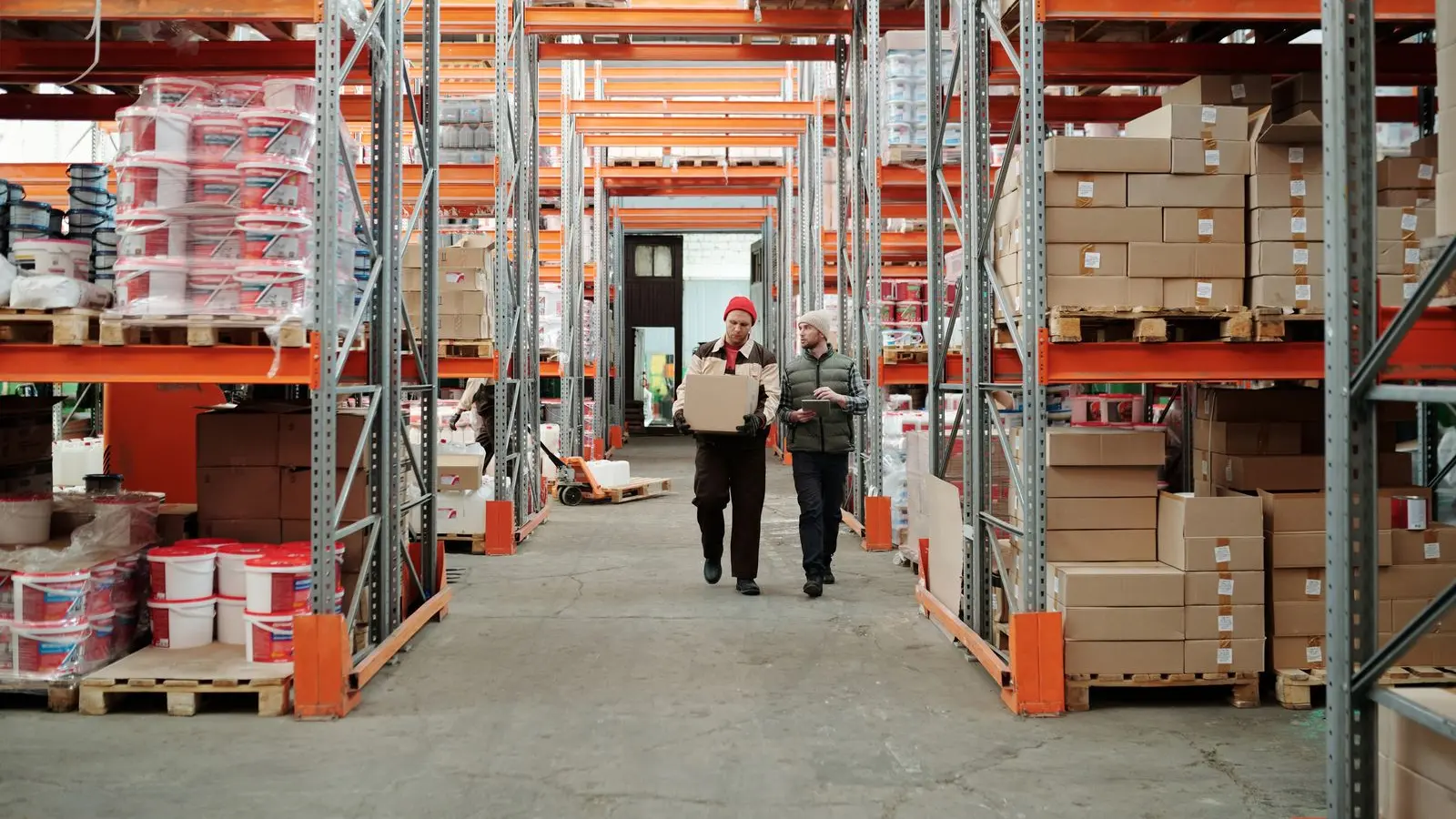
Gemba (現場) is a Japanese term meaning "the real place." In manufacturing it originally meant the factory floor; in a services or office context it means wherever the value-creating work actually occurs — a call centre floor, a claims-processing desk, a warehouse dock.
A "Gemba walk" is simply going there — not to inspect or catch someone doing something wrong, but to observe. To see the workaround nobody wrote down. The extra step someone quietly added six months ago because a supplier once sent the wrong part. The spreadsheet living outside the official system because the official system was too slow.
The walk is a structured way of practicing a broader principle called Genchi Genbutsu, or "go and see for yourself" — the two terms get used almost interchangeably, but it's worth knowing which is the practice and which is the principle behind it.
Why Leadership Can't Delegate This Away
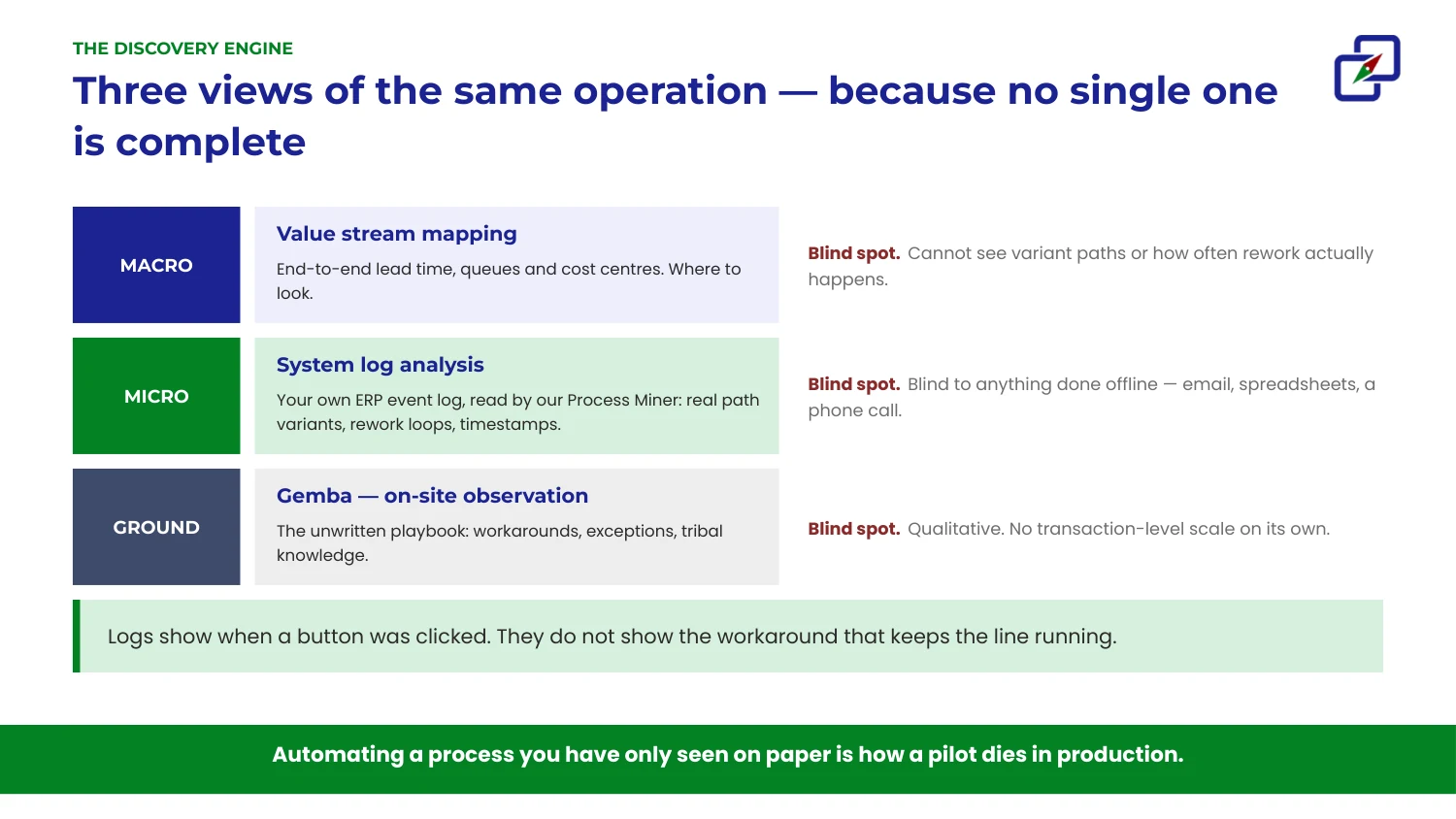
It's tempting to treat this as something a report can substitute for. It can't, for one simple reason: reports only show you what someone thought to record. An ERP event log shows when a button was clicked. It does not show the phone call, the sticky note, or the reason the line kept moving despite what the log implies. Gemba is the only one of Lean's discovery tools that has no blind spot toward the unwritten, informal, "how we actually get this done" layer of an operation — because it's the only one that shows up in person to look.
What a Gemba Walk Looks Like in Practice
A useful Gemba walk isn't a surprise inspection and it isn't a management tour with an entourage. The pattern that actually works:
- Go with a question, not a checklist. "Where does work actually wait?" beats a generic audit form.
- Talk to the person doing the work, not their manager. The operator, the clerk, the technician — they're the ones who know the workaround.
- Watch before you ask. A few minutes of quiet observation surfaces things a direct question won't — people describe the official process; they show you the real one.
- Write down what surprised you. If nothing did, you probably didn't look closely enough.
The One Thing a Gemba Walk Can't Tell You
Gemba is qualitative by nature — it's one operation, observed by one person, at one point in time. It won't tell you how often a given workaround happens across a thousand transactions, or whether what you saw on Tuesday is typical or a one-off. That's exactly why it's one of four lenses we use together, not a replacement for the others — paired with a strategic view (Hoshin Kanri), a macro view (value stream mapping), and a micro view (system log analysis) to check what the floor shows against what the data shows, and vice versa.
How True North Solutions Uses It
Every TNS assessment includes Gemba walks alongside value-stream mapping and system-log analysis — never as a stand-alone exercise. The floor tells us what a process map and an ERP export both miss; the data tells us how often what we saw on the floor actually happens. Used together, they triangulate on the same operation from three directions no single one can see alone.
As Uma KA, TNS's founder, put it in The True North Compass: "The truth isn't in spreadsheets or reports. It's here, in the dust, in the sweat of these workers, in the small inefficiencies we overlook."
FAQ Section
Is a Gemba walk the same as a factory tour?
No. A tour is for showing; a Gemba walk is for seeing. The difference is who's talking — on a
tour it's usually the host, on a Gemba walk it should mostly be the person doing the work.
How long should a Gemba walk take?
Long enough to stop noticing you're being watched. Rushed 10-minute walkthroughs tend to
surface the same "official version" a report would already tell you.
Can Gemba walks work outside manufacturing?
Yes — anywhere work happens that a process map can't fully capture: claims handling, customer
support, logistics dispatch, clinical operations.