Table of Contents
Introduction
A plant manager signs off on an AI pilot. The vendor demo is flawless. Six months later the pilot is still "in progress", the data team is cleaning exports, and the floor supervisors have quietly gone back to their spreadsheets.
The model was rarely the problem. Gartner predicts that through 2026, organizations will abandon 60% of AI projects that are not supported by AI-ready data. The forecast draws on a survey of 1,203 data management leaders, and 63% of organizations said they either lacked the right data management practices for AI or were not sure they had them.
In this article, we'll look at what AI readiness means in a factory, the six dimensions that decide it, and a four-step order for closing the gaps. If you would rather start by scoring yourself, the Lean AI Readiness Scorecard asks eighteen questions and returns a profile when you finish.
What AI Readiness Means in a Factory
AI readiness is the degree to which an operation can define a problem, supply trustworthy data for it, run the result inside real work, and govern it afterwards. It describes the operating system around the technology. Two factories can buy the same tool and get opposite results, because one of them has a process the tool can learn from and the other does not.
"AI amplifies the process it enters."
That is why readiness starts with Lean basics and ends with governance. The question is never only "can the model do this?" It is also "can we feed it, use it, and stop it?"
The Six Dimensions
The scorecard rates six dimensions, with three questions each. This table shows what each one asks and what the two ends of the scale look like on the floor.
The Six Dimensions at a Glance
| Dimension | The question it asks | Ready looks like | Not ready looks like |
|---|---|---|---|
| Lean process maturity | Is the work defined, measured and improved? | Value streams mapped, standard work in use, structured problem solving | The process lives in people's heads and each shift runs it differently |
| Data foundation | Can we trust the data at the moment of decision? | Captured at the source, with consistent definitions, owners and timestamps | Manual re-keying, conflicting units, spreadsheets nobody owns |
| Infrastructure | Can systems exchange data securely without a major project? | Machines and systems give usable signals or exports, with a supported connection | Data locked in vendor silos or on paper, and no one supports the link |
| Organizational readiness | Does someone own the outcome? | A named outcome owner and a cross-functional team with time to adopt | IT owns the deployment and operators hear about it at go-live |
| Use-case viability | Is this problem worth solving this way? | A measurable metric, a baseline, a decision owner, and value that beats the support effort | A broad "AI theme" with no baseline |
| Governance | Who approves, overrides and monitors? | Defined approvals and escalation, risk review before launch, monitoring after | No stop procedure and nobody watching for drift |
1. Lean Process Maturity
Start here, because everything else depends on it. Check whether your priority value streams are mapped and current, whether standard work and performance measures are used where the work happens, and whether teams solve recurring problems at the root. A value stream map built from memory in a workshop is a start. One built from your event log is better, as we describe in how Process Miner builds a value stream map.
2. Data Foundation
More data does not help if it cannot be trusted. Ask whether critical production data is captured at the source, whether definitions, units and timestamps agree across systems, and whether the team can reach data they believe in time to make the daily decision. One reliable data path for one decision beats a data lake nobody trusts.
3. Infrastructure
The test is whether a bounded pilot can run without turning into a systems project. Machines and systems need to give usable signals or structured exports, exchange them through secure, supportable methods, and sit on a network with the access controls and tooling a controlled pilot needs.
4. Organizational Readiness
Technology becomes capability only when leaders, frontline teams and technical owners move together. Look for a named leader who owns an operational outcome, not just a deployment, and a team that includes operations, IT and data people. Trust matters here too: a tool introduced before baseline trust exists tends to measure how well people have learned to perform for it, as we argue in Trust Is the First Tool.
5. Use-Case Viability
A strong use case ties a frequent operational problem to a measurable outcome and a decision someone owns. It also has a known baseline and an acceptable result agreed in advance. The Judgment Lane Classifier helps here: it scores one step on judgment, risk, volume and exceptions, and says plainly when the answer is deterministic software, an AI agent or a person. We cover the same dividing line in Agentic AI vs RPA.
6. Governance
Controls should match the operational risk. Define who approves, who can override, who monitors quality and drift, and who can stop the system. A second, independent check on AI output is one way to build that in, which we describe in Why an Independent AI Auditor Matters.
Strategies for Closing the Gaps
1. Score All Six, Then Fix the Lowest First
Rate each signal honestly, from 1 (not yet) to 5 (embedded in daily work). The scorecard turns the ratings into a score out of 100 per dimension, averages them, and names your three lowest dimensions as the priority gaps. The overall score places you in one of four stages.
What to Do First, by Stage
| Overall score | Stage | First move |
|---|---|---|
| Under 40 | Foundation | Fix the process, the decision and the minimum reliable data path before any AI spend |
| 40 to 59 | System-building | Standardize the weak links around one value stream |
| 60 to 79 | Pilot-ready | Run a controlled pilot on one high-value decision |
| 80 and above | Scale-ready | Keep ownership, governance and measurement in place as patterns spread |
2. Pick One Value Stream and One Decision
Choose a frequent, painful decision, not a broad AI theme. Write down the baseline, the owner, the target metric and the cost of doing nothing. If you cannot, the use case is not ready yet, and that is a finding worth having before a vendor is involved.
3. Fix the Data at the Source for That Decision
Assign an owner and repair capture quality where the data is created, not downstream in a report. Standardize definitions and timestamps for only the sources that decision needs, then test the data against a real decision before building anything on it.
4. Agree Stop and Scale Criteria Before Launch
Decide in advance what result means "scale", what means "stop", who can override, and how the system will be monitored. Keep consequential decisions under explicit human control until the evidence earns more.
Real-Life Case Studies
Case Study 1: Toyota and Siemens in Die Casting
Toyota and Siemens developed AI that predicts abnormalities in aluminum die casting, using approximately 40,000 data points per shot. Read through the six dimensions, the pieces are visible. The process is stable and measured (Lean maturity), the data is captured at the machine on every shot (data foundation), and it is processed close to the machine (infrastructure). Experienced operators stay part of the system (organization). We cover the detail in our Toyota post.
Case Study 2: Amazon's Recruiting Tool
This case is not from a factory, but it shows two dimensions at work. According to Reuters reporting carried by CNBC, Amazon trained a resume-screening model on ten years of past applications, most of which came from men. The model learned to penalize resumes that included the word "women's", and the team behind it was later disbanded. The lesson for readiness is about two dimensions: check what your data encodes before you build on it (data foundation), and review how a model behaves before it scores real people or real parts (governance).
Case Study 3: What We See in Our Own Work
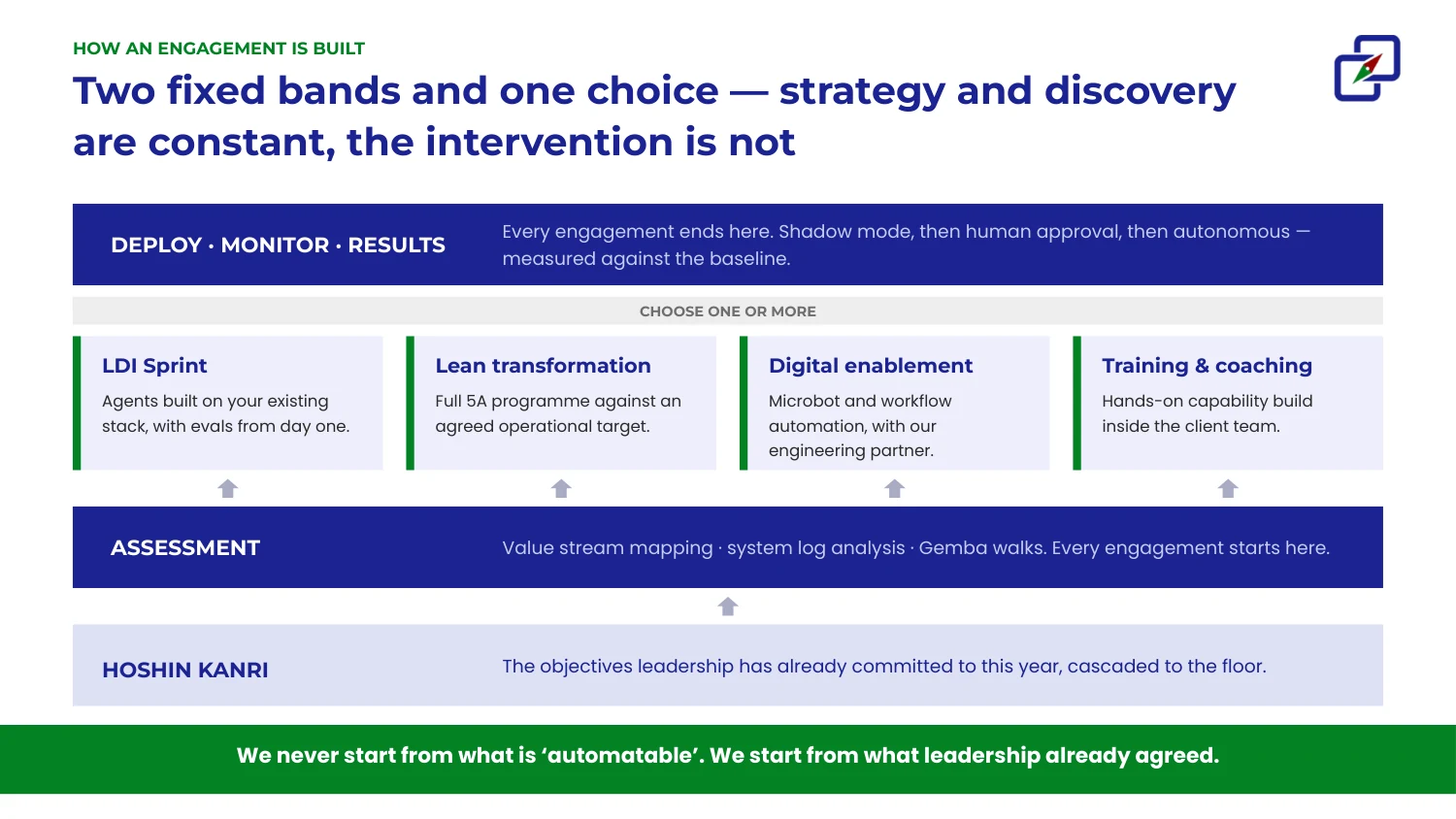
In our five-day assessment, we map the value stream from your own event log and return which steps warrant deterministic automation, which warrant AI judgment, and which should stay with a person. The scorecard asks the same questions as a free first pass, and our other free tools cover each step that follows.
Key Takeaways
- AI readiness is a property of the operating system around the model, not of the model.
- Six dimensions decide it: Lean process maturity, data foundation, infrastructure, organizational readiness, use-case viability and governance.
- Gartner predicts that through 2026, organizations will abandon 60% of AI projects not supported by AI-ready data.
- Fix the lowest-scoring dimensions first, around one value stream and one decision.
- Agree who owns the outcome, and what means stop or scale, before launch.
FAQ Section
Q: What is AI readiness in manufacturing?
A: AI readiness is how well an operation can define a problem, supply trustworthy data for it, run the result inside real work, and govern it afterwards. It describes the operating system around the model, not the model itself.
Q: How do I assess AI readiness in a factory?
A: Rate the operation on six dimensions: Lean process maturity, data foundation, infrastructure, organizational readiness, use-case viability and governance. Three questions per dimension, each scored from 1 (not yet) to 5 (embedded), give a score out of 100 and show the three weakest areas to fix first.
Q: Why do AI projects stall in manufacturing?
A: Data is a leading reason. Gartner predicts that through 2026, organizations will abandon 60% of AI projects that are not supported by AI-ready data. Unclear ownership, an undefined process, and no plan for monitoring after launch are the other common causes.
Q: Do we need a large IT project before starting?
A: No. Prove one narrow data path from the machine or system to a single decision, and document who owns it and who supports it. A broad platform program before a first use case usually adds cost without adding evidence.
Q: Should we fix our Lean basics before adding AI?
A: Yes, for the process the AI will touch. AI amplifies the process it enters, so an unstandardized process gives it little to learn from and the team little to measure. Map one value stream, define standard work, and set a daily performance rhythm first.
Q: Is the scorecard an audit?
A: No. It is a directional self-assessment that shows where to look first. It is not an operational, cybersecurity or compliance audit, and it tests your own view of the operation. An assessment on real data tests that view against what actually happened.
Conclusion
Back to the pilot that stayed "in progress". The vendor demo was fine. What was missing was a defined process, data someone owned, and an agreed way to decide whether the result was good enough to keep. Those are all things a team can check before spending anything.
Where would your operation score? You can take the scorecard today. If you would like help turning the result into a plan, get in touch.